Madrid Duende
Autofiction for Monster/Mother's Day

It costs a lot to be authentic, darling. And one can’t be stingy with these things, because an authentic thing is the most beautiful that there is.
—Agrado in All About My Mother, Pedro Almodovar
My mother, through the psychic medium, had told me, “Stop having my voice in your head. I’m not mad at you anymore.”
I felt irritated that my mother, beyond the veil, would try and control how long I had her voice in my head, and I sort of wanted to keep the voice just out of rebellion and spite, but I was pretty sick of it myself, honestly. The Mother Demon came like an intrusive thought, a disappointed scolding. She said, “Why can’t you just wear some lipstick, Ariel?”
The funny part is that I do wear lipstick now. I always do my nails red, too.
My mother hissed, “That red’s too dark.” She said, “Everyone thinks you’re stupid, Ariel.”
That used to make me feel sad and afraid when she said that, a tingling pressure behind my imagining everyone thought I was stupid, but now I talked back to the idea of it. I mean, did they? Think I was stupid? Did anyone even care? Who gives a shit about anyone else’s IQ?
My mother sighed, “You’ve put on weight, Ariel. And I’m only saying this because I’m worried about your health.”
But what did a little perma-postpartum belly ever have to do with anyone’s health?
My mother said, “It’s just too bad you’ve destroyed your teeth.”
Well, she was probably right about that.
I remembered when my mother lay on her deathbed screaming “I hate you!” I finally shrugged into it and said, “I give up, Mom. Why do you hate me?” And that’s when she spilled it, like she’d been waiting all her life for me to ask. She said, “I hate you because you have a life and I have no life.”
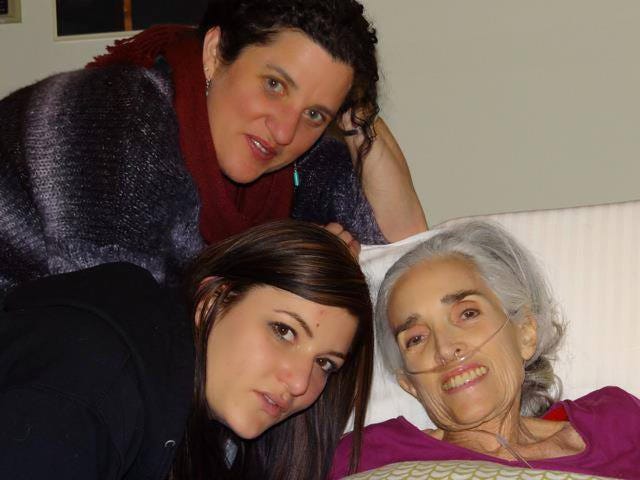
It made my heart hurt to hear her say that. By then her life on this side of the veil had just a few weeks left to it, but I suspected she’d felt that way for a long time. Motherhood asked her to give up her freedom, and her dreams. My mom’s life looked rose-tinted to me from the outside—like something you could have only if you were straight and a Boomer. She had an old Spanish craftsman with her own art studio in the back yard. She had my stepdad, who loved her beyond reason. Everyone called her beautiful, charming. What did I have that she didn’t? I would have given it back to her. I would have given it back to her with strawberries and whipped cream on top, but the cream might make us fat.
My friend Karin says she thinks it was common, among the mothers of Gen X. They’d come up in the 60s. They’d developed all of these feminist ideas. And then they got stuck in these domestic situations.
I don’t know why that line from All About My Mother popped into my head right then, but it did. And thinking of Almodovar made me want to go to Spain. I still had one round-trip flight voucher.
I booked the ticket last-minute, read Federico Garcia Lorca in translation on the plane. In his lecture “Theory and Play of the Duende,” he tries to explain the unexplainable dark muse every artist knows, “The Duende, then, is a power, not a work. It is a struggle, not a thought. I have heard an old maestro of the guitar say, “The duende is not in the throat; the duende climbs up inside you, from the soles of the feet,” Meaning this: it is not a question of ability but of true, living style, of blood, of the most ancient culture, of spontaneous creation. This “mysterious power which everyone senses and no philosopher explains” is, in sum, the spirit of the earth.”
I rented a tiny room on Calle de Atocha with a shared bathroom and a window that looked out on another window. I slept through the first day and night, woke to a shaft of light through that single window, and put on my new green linen dress—printed with pink and black and white snakes, each wearing one cowboy boot. I figured the snakes would give me excellent serpent-power and their cowboy boots would make me laugh.
The spell:
Go see Picasso’s Guernica
And figure out how to end this war with my mother
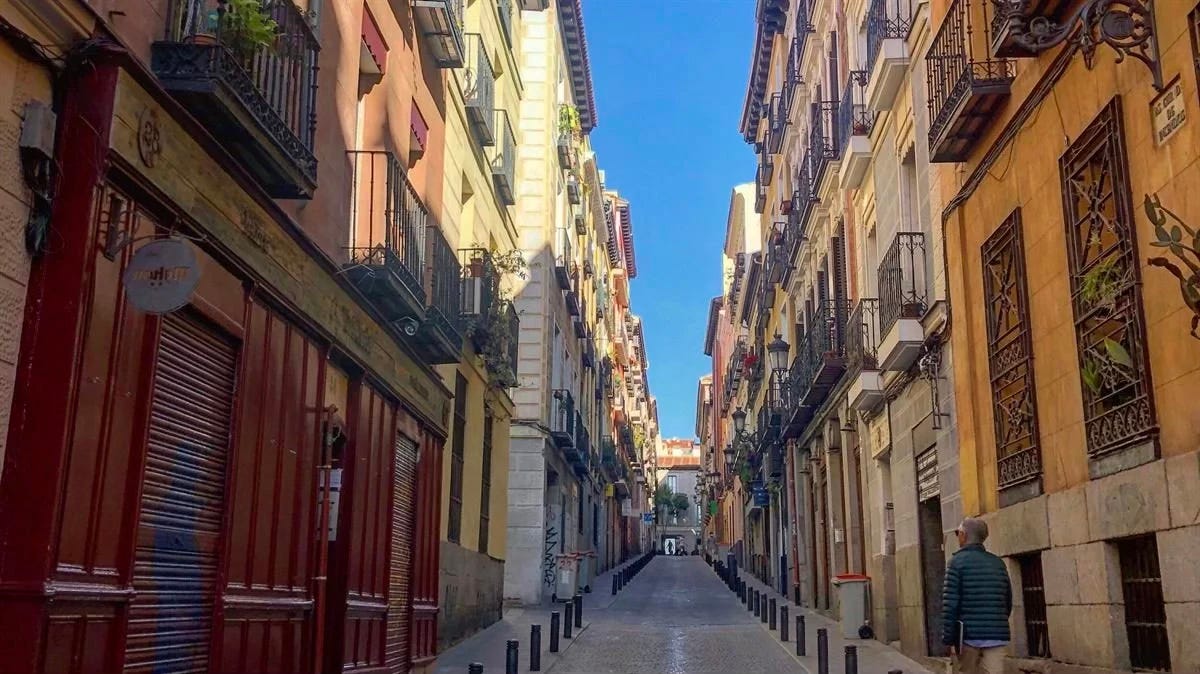
Downstairs on the street, I ordered a double espresso. I felt sad about how bad my Spanish is, and reminded myself it would get better in a couple of days, but I wasn’t planning on staying. I walked the few blocks down to the Reina Sofía, because that’s where my little robot said I’d find Guernica.
When I turned onto an alley I noticed my mother’s spirit walking next to me. I looked at my phone and puzzled at the date. I’d come to Madrid on the fourteenth anniversary of her death. She wore a black leggings and a black T-shirt. It felt easy to walk with her. When she was alive she always stressed me out. Like, I was afraid she was going to start some shit. Now she seemed small, a little person who wanted to go to a museum and didn’t have her own ticket. “Did you ever see Guernica?” I asked. “When you were alive?”
“No,” she kept her eyes on the street. “I’ve never been to Madrid before. Just Barcelona.”
I had the distinct memory that she’d come here with her own mother, on their last trip together. Maybe I was mistaken. Or maybe ghosts sometimes lie and forget, just like the living. We turned onto Calle de Santa Isabel and two giant glass elevators jutted into the ancient architecture. I wanted to lifted off in the spaceship of them, but my mother wanted to take the stone stairs, and head straight for room 205, and Guernica.
The ticket person stopped us, and I showed her the code on my little robot, did we want the audio tour?
Of course we didn’t want the fucking audio tour. My mother jumped up and down next to me, but I didn’t want to consult her on this one. “No, gracias,” I said out loud.
“You’ll learn things, Tiniest,” my mother whined. But it always stresses me out, how they try to give you those headphones in a gallery. Like it should be the one fucking place in the world where you don’t have to listen to someone spewing words you could perfectly well look up if you were interested.
“Let’s just go,” I whispered.
Maybe she wasn’t mad at me anymore, but she clearly thought it wasn’t fair that I was the alive one who could make elevators go up and down with the touch of a finger.
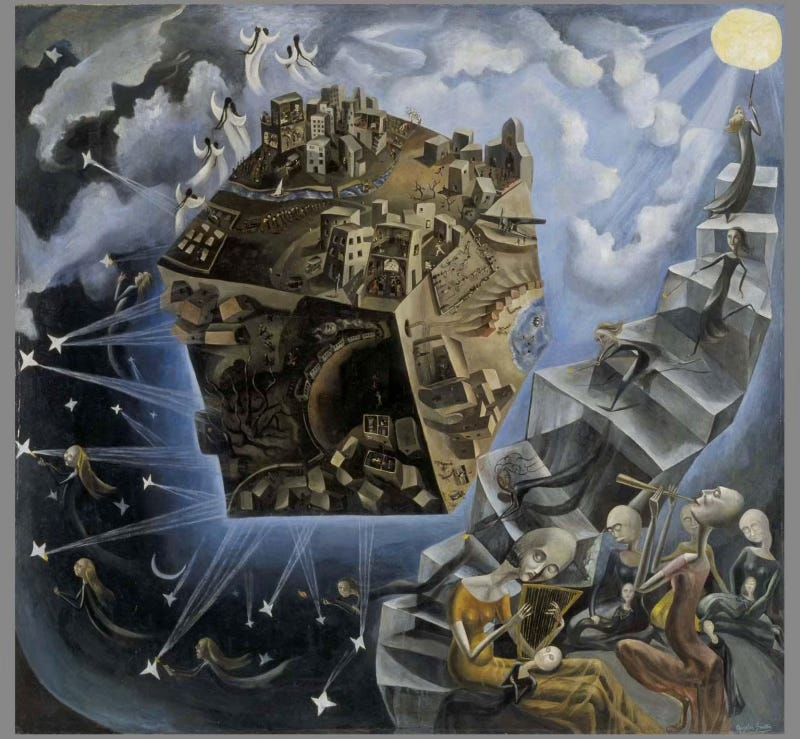
I slowed where a crowd had gathered—maybe this was Guernica—but when I craned my neck, here’s Un Mundo. Some woman with an English accent stood behind me telling her friends, “Ángeles Santos painted this when she was eighteen.” People just can’t shut up. The painting whispers. It’s a cubed-shaped planet that morphs into an emotional world. As I stared into the sky of it, I closed my eyes and portaled into its world to fly around with its fairies.
“This is a cool one,” I said to my mother.
And she stayed silent. I had always loved staying silent with my mother.
When I was a little kid, I scrubbed the Mexican tiles in the bathroom with my mother’s anxiety and perfectionism. Spotless tiles meant no screaming. When she painted, out in her studio, she spread crimson anger across canvases. It was important not to interrupt her; not be the reason the art was ruined now. The way I ruined everything. But in an art museum, with its pristine walls, surrounded by paintings and sculptures that were finished, perfect, ready for community engagement—that’s where my mother could exhale. Nothing to scrub.
“Look,” she said. She pointed at one of Picasso’s sketches for Guernica—and there was the mysterious star that had appeared on my palm—the one I’d been asking all the psychics about. Picasso drew it in pencil, in 1937, in presumably someone else’s hand.
I showed my star to my mother.
She blinked. “You have always been so weird, Ariel.” And she disappeared.
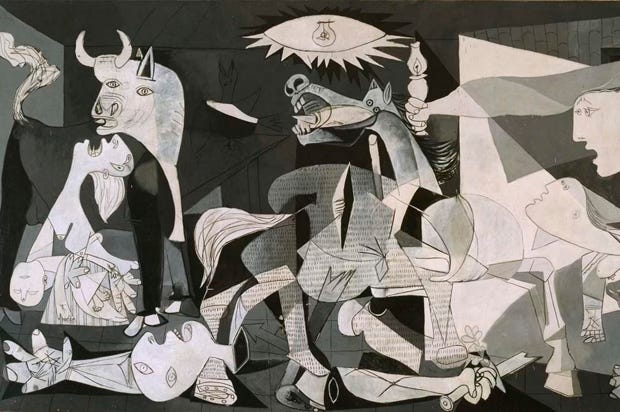
In the grey and marble-floor quiet of room 205, I stood in front of Guernica—it’s big—wouldn’t fit in my apartment in Oakland—and beamed all the other onlookers out of my field of vision and I stared at that black and grey painting until I became every gnarled foot and every reaching arm and became the horse’s whole terror and all the bull’s rage and every screaming disembodied head—that mother holding her dead child. I portalled into the terror of the whole thing, and flew into the eye of the lightbulb above, and then I landed back in front of it, standing next to my mother’s spirit.
“It’s a pretty good painting,” I said to her.
My mother tugged at my wrist, and pointed to another study, this one titled Mother with Dead Child: Postscript to Guernica. I wondered, quickly, if she’d lost a baby before she had me. She stood next to me now, but I didn’t ask. She drifted into an adjacent grey room, toward Magritte’s Pink Bells, Tattered Skies. “This whole place is heaven,” she said, and that’s when I realized she would stay here. She’d flutter herself into each surrealist painting, each projection of Spanish dancers on the gallery wall. She could relax here, finally, between this famous painting of war and another famous vision of a sustainable and magical cube-world. If you go to the Reina Sofía, you might see her, in a desperate fist of Guernica or among the femme fairies in Un Mundo, borrowing fire, lighting stars.
Outside, I followed a magpie into the Retiro, wandered under the London plane trees with all the dog-walkers. I watched the lovers in their rowboats on the lake, bought some spicy cornchips for later. I knew I’d gotten to the Ángel Caído—the fountain of the fallen angel—because there were all these goth kids gathered around, smoking cigarettes. As I inhaled their secondhand air, I missed my youth. So many cigarettes, so much smoke.
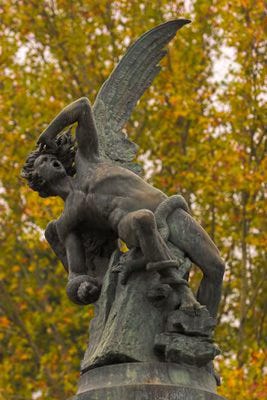
The duende surges up, inside, from the soles of the feet.
—Federico Garcia Lorca, Theory and Play of the Duende
I’d heard of this statue before—it’s the only public monument to Lucifer in the world and it’s supposedly 666 meters above sea level—but I’d never heard that around the base of the statue, a circle of demon figurines crouched in the stone. I started counting them. How many demons did Lucifer have? I got to seven, then eight, then lost my place. I circled again. Eight. A barn swallow flew in and out of the spaces between them, unbothered.
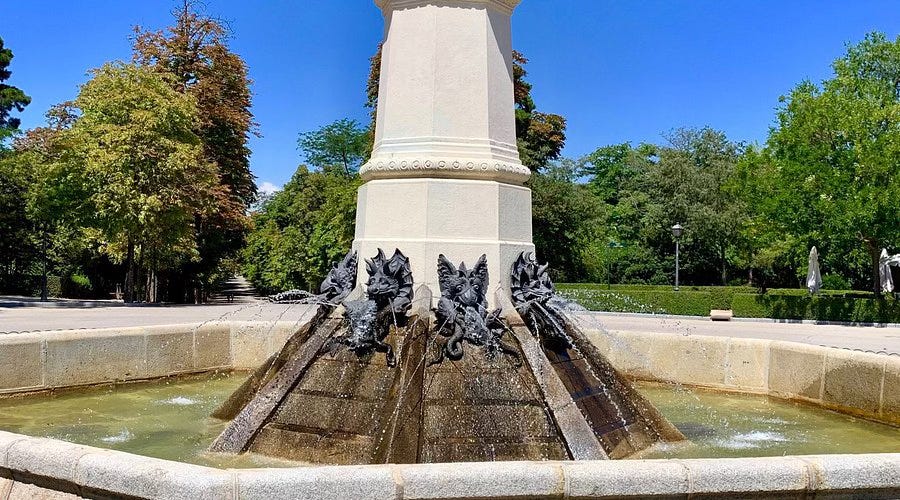
Lucifer + 8 Demons. What did it mean? I had nine demons and Lucifer only had eight? I circled the statue three times, then three more times for good measure. How could I exorcise my mother demon? My uterus hurt. I smoothed my dress.
The duende wounds, and in trying to heal that wound that never heals, lies the strangeness, the inventiveness of a man’s work.
—Fredrico Garcia Lorca, Theory and Play of the Duende
I stepped over the low fence and tiptoed through the strip of daisies and tulips and I climbed over the low stone wall into the octagonal fountain, one side for each of Lucifer’s demons. The goths were still smoking their cigarettes and the tourists and the dog-walkers still wandering by, but the nice thing about being white and middle aged is that no one notices you or what you’re doing. The water felt warm. I squatted until I was submerged to my waist. I pushed hard and the blood gushed out thick and I pushed again as I gave birth to my mother demon and I pushed one more, just to make sure it had vacated, and the water all turned the color of my dark nails, and blood poured out through the mouths of all Lucifer’s demons and I catapulted out of the water and shot through the clouds and landed on my feet at the edge of the crowd of goths and none of them noticed I was covered in blood, but one of them offered me a cigarette. I felt a flutter of nostalgia for the desire to stain my teeth and burn my lungs, but I shook my head. “No, gracias.” And from there I headed back toward my room, all peace and quiet in my head. Spray painted graffiti on a stone wall said, “me acepto como soy.” Maybe I’d stop to pick up some strawberries and cream puffs on my way.
*